


Some reflections from an intense period of AI-assisted software development. We have entered a new era in some ways, but how new is it really? Hop to the Distilled Spirit for an exploration of the war for our attention and more. Don’t miss this week’s banger.
Does Code Write Itself?

Much of my professional life has been spent building software. For a period it was nearly all-consuming. I probably should have stuck with coding in hindsight, but I segued away from active development in the mid-2010s. Recently, the new wave of vibe coding tools and some slightly different professional circumstances have brought me back to the pointy end. We are in the vibe work era, but I will not claim I have been vibe coding in a pure sense. But I have spent enough time with the new tools to get a sense of the value and how things have changed.
The Vibe Coding Trip Report
Vibe coding—software development powered by AI—is definitely not hype. It’s real, powerful, and a hell of a lot more fun than slogging through scaffolding code by hand. There are massive productivity gains.
How do I know? I spent a long time in software development, from humble Access databases and office integration, to PHP and ASP scripting, into the deep end of C# and complex ASP.NET applications layered on top of SQL Server and RavenDb. I even wrote a few books about it. Then I made the biggest mistake of my career: stepping away from it in the mid-2010s. Aside from a few no-code toys and occasional scripts, I was out. Now, I’m catching up fast—and the tools are mind-blowing.
The new wave of vibe coding tools are making the business of building real software a lot more accessible. I’m still fighting the toolchain; I know C# not TypeScript. Monorepos are a new and interesting concept. Even though I have been in new and uncomfortable territory, these tools have helped me get rolling fast. I have become productive on a new stack a lot faster than I ever have before even though I was a long way away from playing shape.
Things That Work Very Well
Clean, Complete and Clear Instructions: just like any other AI tools your coding tools do better the more complete and clear the instruction set is. This is not any different in the inputs, but the output can be more magical — or dangerous.
Code Scaffolding & Reuse: The speed here is wild. Cursor feels like ReSharper on steroids—boilerplate just flies in. I often find myself thinking in terms of, "make a function to take this input and produce that output," and Cursor eats that instruction up and builds the function on the spot. It gets it right 85% of the time, which is often good enough to roll with or tweak.
Debugging in Cursor: If you drop your stack trace or error message in, and it spits out an explanation and a fix 90% of the time. If you've been through the pre-Google, pre-StackOverflow era, this is witchcraft. The AI can see your code and often gives the right specific example, even for pesky infrastructure integration bugs. It is amazing at finding race conditions and more nuanced bugs as well.
Test Driven Development turns out to be a sweet spot for AI coding. The framework of the tests gives you a specific set of instructions and a natural scaffolding for the AI to reason through behavior. The structure lets you and your partner iterate quickly and then easily verify results. Having a real, functioning definition has always been a development superpower; AI multiplies it.
Focused System Parts: These tools shine when you hand them responsibility for specific, well-bounded layers in your system—things like UI scaffolding, data formatting, or endpoint glue code. Don't ask them to architect your app from scratch, because that’s not where the value lies. The real win is replacing chunks of human-generated code with machine-generated alternatives that could themselves be swapped out entirely. It’s a black box approach—get the boundary and interface right, and let the machine cook.
Documentation + Diagrams = Superpowers: The System Design newsletter and ByteByteGo are cheat codes. These diagrams help structure instructions for vibe coding tools and translate complex systems into things a co-pilot can build. Don’t forget about tools like Notion—this piece breaks down how you can use it to capture requirements and pipe them directly into your dev environment with MCP. It’s a clean bridge between messy human intent and structured machine-readable work.
Things That Work Poorly
Imprecise Instructions: These tools are fast, clever, and shockingly helpful—but they’re not psychic. If your prompt is fuzzy or underspecified, the output will be too. You’ll spend more time rewriting than you would have just writing the thing yourself. AI thrives on clarity.
Surgical Updates: These often fall flat unless you lay out exactly what needs to happen. The models don’t reliably reason across files or deeply grasp application state. You can’t just say “rename this and update where it’s used”—you need to walk them through like you would a junior dev. Otherwise, expect broken references or invisible side effects.
Maintainability: The code often looks right, runs right, and even tests clean—but it can be brittle, overly specific, or redundant. Generated code doesn’t think in terms of longevity or shared ownership. So render unto the code generator what is the code generator’s: repeatable tasks with clear inputs and outputs.
Things I Want To Try
It is really one thing — I just have not been organized enough, nor working on projects large enough, to justify engaging with the real agentic workflows. Cursor Agents and ChatGPT Codex are really built to handle longer term, larger scale problems. I am excited to turn them loose on a few things now that I am wrapping myself around modern architecture.
On the same vein — I want to use those frameworks as a static code analysis and check and balance tool. The eyes to make sure one does not introduce subtle bugs without getting full-on TDD and 100% test coverage goals.
Tools I’ve Been Loving
Beyond just AI copilots, the modern dev stack has gotten wild—in a good way. Here's what I've actually used and liked. This isn’t an endorsement of a particular direction so much as a snapshot of what’s working for me right now. There are loads of great platforms out there—software is amazing like that.
Cursor just felt like the best AI-assisted coding tool and worked with my workflow out of the box. It seems to be leading the pack. The interface is tight, context handling is solid, and the ergonomics are developer-first in a way a lot of the other tools aren’t. Don’t sleep on feeding your specs into Cursor via Notion MCP—it’s a great workflow for scaffolding quickly.
Cloudflare’s developer platform combines a few beautiful things. It has everything you need for a modern serverless stack. The price is right with a generous free tier and cheap paid plans. Wrangler just works. You can build and deploy in minutes. It’s hard to overstate how much fun it is to ship like this.
Supabase is very, very powerful. D1 is growing on me, but I still prefer to have the full weight of Postgres behind me. The command-line tooling is what I dreamed of back in my dev days. It’s also been interesting to return to a more DB-forward workflow—row-level security as a first-class primitive feels like the right kind of opinionated.
Lovable is still early, but I love it for making disposable UI spikes over APIs or wrapping services like Airtable. It’s playful, quick, and when it hits, it hits. Cursor’s pretty good at this too, but Lovable has a special energy.
Claude has been a great advisor, especially when I want a different second opinion or need to reason through complex code. Claude Code looks powerful but it’s been a pain to use on Windows, so I haven’t done as much there.
ChatGPT Codex is another one I need to spend more time with, especially as an auditor—having it review and critique work from other tools seems like an underrated use case.
There is no shortage of tools. But this stack is working for me. And I’m always open to hearing what else is worth playing with. I know people love Vercel, Railway, and Replit, and I’m poking at all three. Open to hearing what folks are loving for deployment, auth, observability, and ops in the vibe world.
Walking on the Shoulders of Giants
Here’s the thing: software has always been about abstraction and tooling. Once upon a time, you had to write assembly. Then we got higher-level languages, frameworks, libraries, package managers. The idea that we could eliminate or reduce the role of “pesky technologists” is old hat. SQL was designed for managers, not developers. Microsoft has built a new rapid application development platform every decade like clockwork. Vibe coding is just the latest instantiation of that dream.
But it doesn’t remove the need for thinking and discipline. You still have to structure your problem, define your components, and explain what you want in terms a machine can act on. AI can help, but it’s not magic.
If you know what you’re doing, it’s like having an army of junior developers who never sleep and never forget syntax. They won’t architect the system for you; in fact giving them too much leeway is dangerous. But if properly instructed and coached they can be very effective if not particularly creative.
The Bottom Vibe
We’re in the Vibe Work Era to stay. For software development the tools will let you get amazing things done — if you know how to instruct them well enough and have the patience to work out the kinks. Honestly, it was not unlike writing this post with the help of AI. Or making the header graphic. Practice, tool chains and practice with your tool chains help a ton. AI is a hell of a way to augment your workflow but it will not replace real creativity or hard work.
Musical Coda
The Distilled Spirit
Wars of Attention
How attention is the new oil and we are already at war over it.
😲 Attention is the Last Scarce Resource (Rex Woodbury)
As the amount of content in the world skyrockets so does the competition for the last scarce resource — your attention.
🤪 Everyone is Crazy Now (benn.substack)
Online attention is the currency that makes everyone mad.
👨⚖️ The Weak Case Against Social Media ( Conspicuous Cognition)
Everyone knows that social media broke America. But did it really?
MCP and Vibe Coding
MCP is amazing, fun to vibe code and potentially dangerous.
🏢 MCP in Corporate AI Strategy (The Strategy Stack)
MCP is the missing layer in your corporate AI strategy — capable of injecting the specific bits of context needed to keep things aligned — in a way other tools cannot.
🔨 Build Your Own Monetized MCP (Remote MCP blog)
A really great example of how to build a monetized MCP server on CloudFlare.
🦹♂️ How AI Can Steal Your Private Data (Aidful News)
MCP servers are exciting but they are also a gaping vulnerability ripe for attack.
Thinking With AI
Tools like NotebookLM can make AI be an amazing thinking partner.
🏛 Magic Cards and Magic Bottles (Steven Johnson)
How Steven Johnson sees the new NotebookLM featured notebooks growing.
📓 New Notebook LM Features (JournalistsToolbox.ai)
A really good and detailed tour of NotebookLM’s feature set.
🧠 Using AI as Your Thought Partner (The Operator's Handbook)
Sure AI can help you do things, but it can also help you think.
✅ Using AI to Check Your Biases (AI blew my mind)
You hear a lot about how AI can amplify bias, but you can also leverage it as a tool to check against common biases and belief traps.
AI At Work
How to use AI at work today.
👨🔧 Your Most Important Hire for 2026 (Work3 - The Future of Work)
Why you need an AI Operations Lead and what they should do.
💃 How a Product Manager Uses AI (Idea Kitchen)
Using AI to imagine and prototype software products.
🏫 An AI Workspace for Educators (Handy AI)
Some ideas on how to use ChatGPT for the educator in your life.
📈 5 Stock Analysis Prompts (Kevin / 100 Bagger Hunting)
Grok has it’s uses — like real time stock analysis.
🧊 AI Markets have Crystalized (Elad Gil)
Legendary investor Elad Gil walks through a rapidly crystalizing AI application marketplace.
Fun Stuff
🏈 Fantasy Preseason Starts Now (The FF Newsletter)
Time to get started on the draft board.
🤠 Country Music Takeover (Daniel Parris)
A statistical analysis of how what was once called ‘hillbilly music’ has taken over the top 40.
🍔 Roy Rogers is Back (Yahoo! Life)
Roy Rogers was my favorite fast food place growing up. Sadly they almost disappeared, but a franchise owner held out, fought Marriott and won the right to build the chain back up again.
The Look
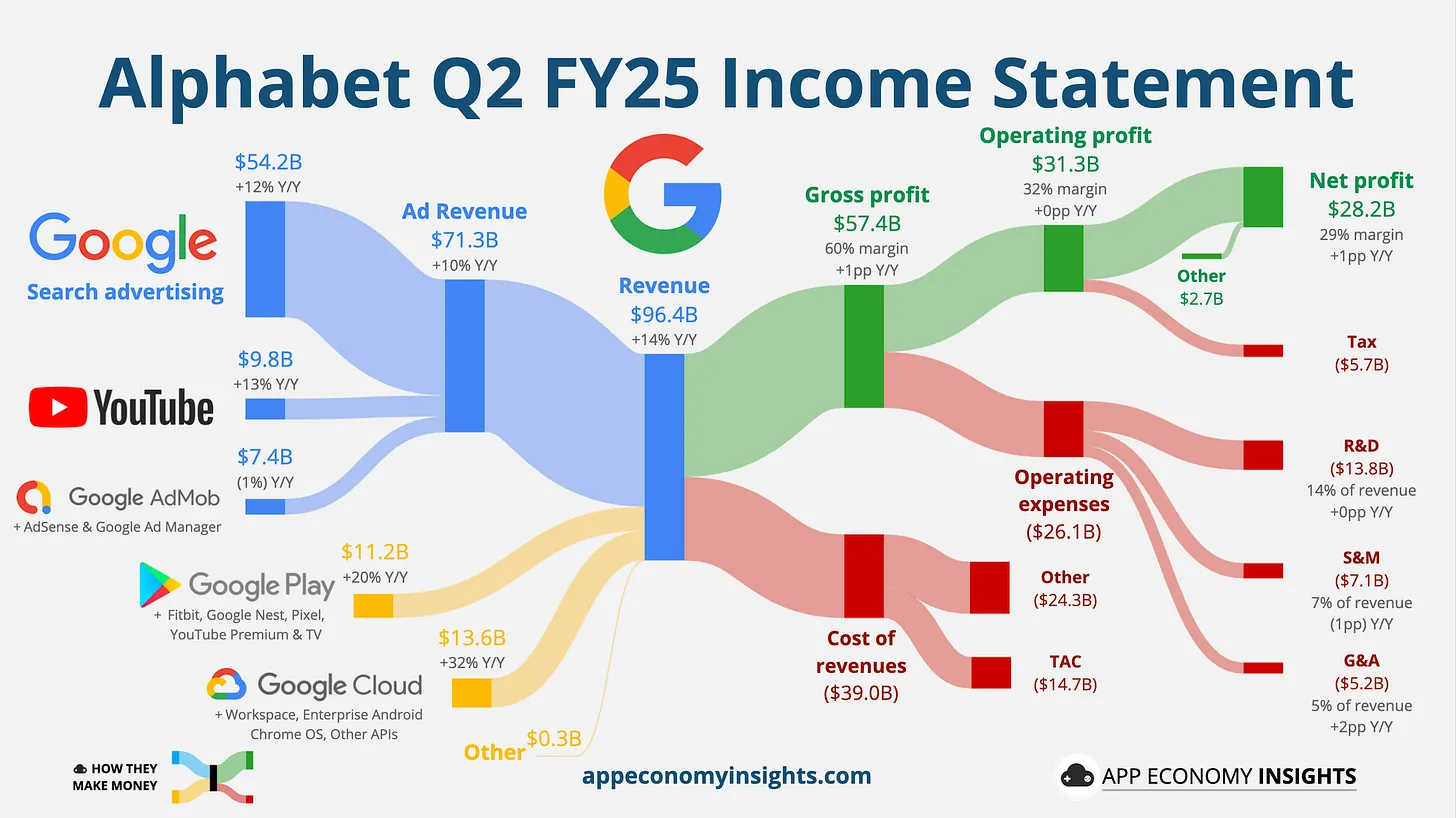
Google prints money via App Economy Insights.
Did you enjoy reading this post? Hit the ♥ button above or below because it helps more people discover great Substacks like this one and it helps train your algorithm to get you more posts you like. Please share here or in your networks to help us grow!
Great deep dive on both the power and pitfalls of these AI tools.
Thanks for mentioning my work!
Appreciate the shoutout Wyatt - thank you man !