


Better Integration Through Chat
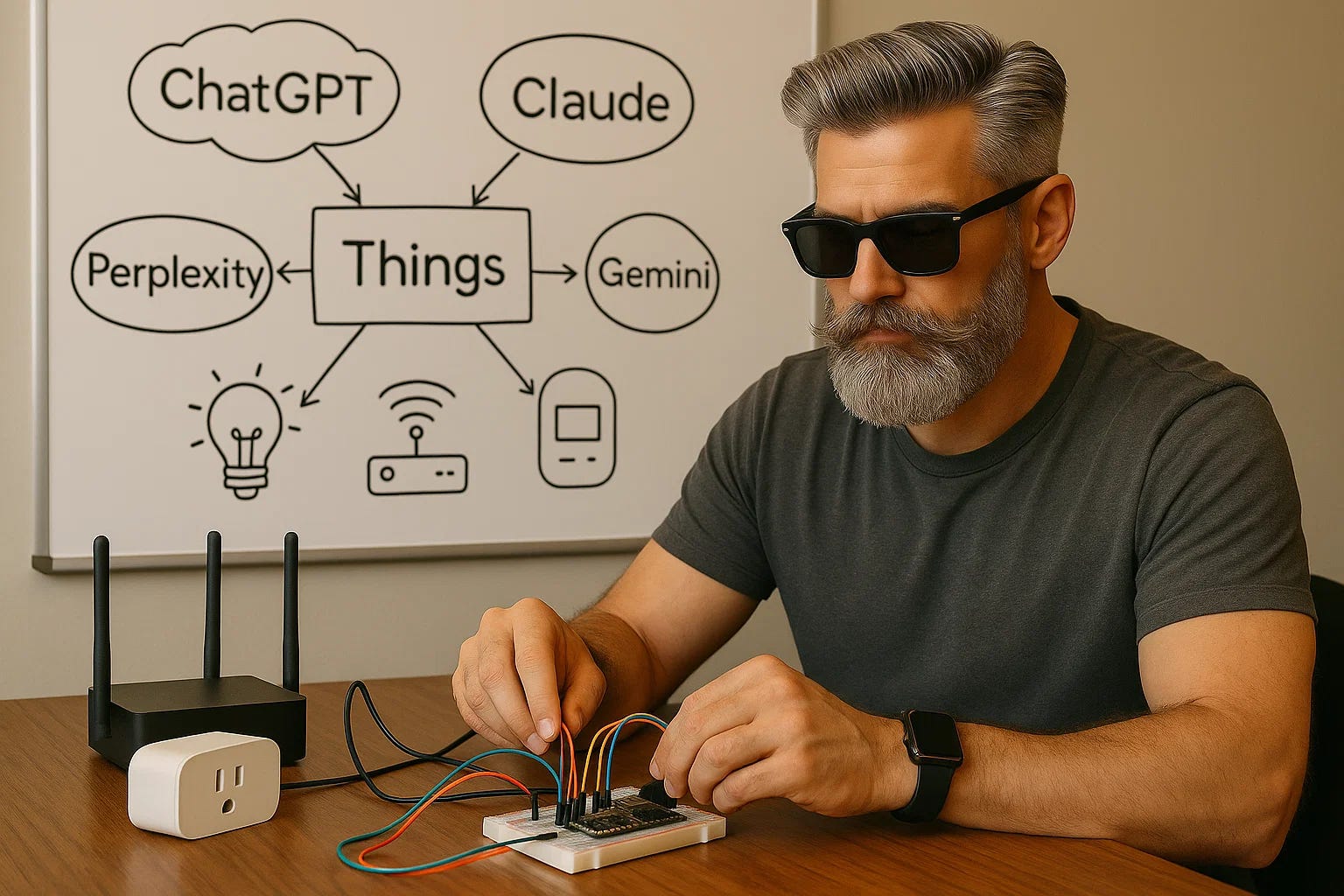
For most of history, copy-and-paste was the only way to get things in and out of your AI chats. This is rapidly changing as a slew of integration technologies come online. Major chatbots— ChatGPT, Copilot, Claude, Perplexity, and Google Gemini—now offer multi-layered connectivity. Connecting things always sounds great on the surface, but impedance mismatches and security can make getting actual value from the connection challenging. It feels quite a bit like the dawn of the internet era when we were putting everything into the browser. Ultimately that won the war, but it was not an easy road to get here.
What Works Today
Connectivity is arriving across the board. This is moving rapidly; the information here will evolve quickly, but here’s where things stand today on each platform. One overall suggestion is to apply some personal governance on each platform. Carefully consider what tools you are enabling where, think about how they could be exploited especially in concert. The principle of least privilege is a great place to start.
ChatGPT: Aggressive Consumer App Positioning
OpenAI is being very aggressive about positioning ChatGPT as a consumer everything app. It offers connectivity in two ways. First there are what they call connectors. These MCP connectors are enabled for a number of apps you use today. Google Workspace has special, deep integration. Beyond that most major tools are included, such as Microsoft 365, Box, Slack, Notion, and Canva. On top of this, they have a new feature called Apps, which are in beta. This promises deeper integration with tools, where they can manifest and present their own interface rather than having to pipe everything through JSON.
ChatGPT seems to have separate universes for its collaboration tools. You cannot bring your connections into a chat inside a project or using a Custom GPT. On the plus side, connectors do work with tasks, which can enable some interesting workflows. Across many of these tools, you will often find that the search is constrained and does not get to the bottom of the proverbial well. ChatGPT seems to be especially bad about this—I have to argue with it to keep looking much more than Claude.
Claude: Serious Business Here
Anthropic arguably started this connection business by investing in and publishing the MCP standard. They feel like they have a bit of a lead in implementation too—it often feels smoother and works better than peers. Anthropic’s integration library is strong; tools like Ramp and PayPal enable workflows like “pull my financials and build a report” directly.
When it comes to using it—the integration just feels a bit smoother than ChatGPT. You have fewer arguments about going deep. This creates another challenge for the user; you can easily run into token limits depending on your account. Claude can do a lot but it has a price.
Microsoft Copilot & Google Gemini: Amazing Walled Garden Experiences
Microsoft Copilot does not have the same sort of connectors the other apps have, but it is built around a deep connection to your Microsoft 365 data. If your life is in OneDrive, Outlook and Teams this is the tool for you. The integrations have been there a while, but Microsoft is starting to build more useful tooling around them. Worth another look if you passed on this a while ago as completely useless. It is pretty good within its walled garden. Google Gemini is another member of the walled garden club. It has very deep integrations with Google services but little else on offer in the way of integration to its chatbot.
To be fair to both vendors—they make their office suites widely available for connection, they can argue that if you really want to use ChatGPT with Outlook data you can. They are more focused on adding value for their enterprise customers who might want the walls around the garden.
Perplexity: Comet-Enabled Future
Perplexity has a different angle than most of the big AI chatbot providers. They don’t own a model, they have fundamentally been systems integrators from the start. They have enabled connections for a handful of applications including Google Workspace, Outlook and Notion for Pro users. These are available across the tools and in conjunction with other data sources.
More interestingly, they created Comet. It is an AI-enabled browser that bridges your Perplexity, including your connections, with the rest of the internet. It can be amazing for things like using AI in places that have good browser but bad AI integrations. You can bring AI tools together—like having Perplexity fact check a ChatGPT answer. With this power comes danger. Keep things logged in and enabled to a minimum to decrease the attack surface and potential depth of exploitation. Stay safe out there.
Connecting the Chats
The catchphrase of the smartphone revolution was “There’s an app for that!” A decade later, that term rings pretty true. It feels like the next wave is connections between apps and AI chatbots. We are going to be asking “Is there a connector for that?” before too long. You will expect your AI to be able to talk to your email and your bank account the way we expect anything to have a website and an app today.
Not unlike the dawn of the internet era, challenges abound. All of the tools have their limitations. You will frequently have to fight the tools, some more than others, to look at the whole file. Context windows fatigue and usage limits hit fast when you are sharing data. And the connectors go two ways. There is more than one app in the store that is more a signpost or placeholder and doesn’t hold up in practice.
Security is the other challenge. We are connecting applications in ways many applications never dreamed they would be connected. We are making it easy for attackers to inject malicious instructions into documents and get access to many resources. This is not a flaw in a specific tool or something that is patched. Much like the early internet, we need to invent the checks and balances to give AI apps the trust networks to go free. As things stand today, I would carefully compartmentalize your apps. All the tools have on/off switches for connections, make aggressive use of them at least. Be careful about any connections you do make, limit access and permissions where possible. Connection is always tough to implement but powerful when done right. With great power comes great responsibility.
The Distilled Spirit
China, Rare Earths and Drones
👊 China Does Economic Coercion Too (Programmable Mutter)
Economic networks are now much more China-centric and the bureaucracy they are building can be used for more than rare earths.
🔊 China’s Export Control System (High Capacity)
A deep dive into the Chinese export controls currently roiling the markets.
💸 Army Drone Fighting (Weapons and Strategy)
Drones might be the biggest change in warfare since telecommunications and vendors are taking note.
AI: Bubble or Not?
🃏 AI’s House Of Cards (Interesting Engineering ++)
One of the best sober discussions of the AI investing ecosystem I have yet seen. Great background for your invetment decisions.
🫧 Bubble Narrative Distraction (Artificial Intelligence Made Simple)
AI investing is not a Ponzi scheme. It is a circular scheme to benefit NVIDIA.
🐘 The $4.5tn Elephant (Clear-Eyed AI)
NVIDIA holds the cards and it is shaping the AI debate for their ends.
AI: Philosophical
🫥 Invisible Work (Rahim Hirji)
Visible work is being fast automated. Your human superpowers lie in the unseen.
🎞️ Generative Video Might Be Good (The Diff)
With Sora2, everyone is worried we won’t be able to believe short videos anymore. Is that a bad thing?
🙈 AI’s Effects on Intelligence (The Generalist)
Outsourcing your thinking might lead to brain atrophy.
AI: Practical
📖 How to Use AI Right Now (Ethan Mollick)
What you should be doing in AI today according to one of the best minds in AI.
🗣️ Stop Prompting and Start Chatting (The AI Creator Drop)
Treating prompts like syntax that can be perfected only gets you so far; they call them chatbots for a reason. Be iterative for the win.
👷 Making Agents Work For You (Peter Steinberger)
Peter shares how he is using ChatGPT Codex CLI to work for him.
Building Things
🚀 Manufacturing AI is Hard (Shear Force)
Manufacturing is much harder to transform than knowledge work.
🔨 High Impact Matrix (Itamar Gilad)
I hate most versions of b-school 2x2 matrixes, but this one looks more useful than most.
🏭 Factory Tours (Scope of Work)
Factory tours are harder to find but they are still pretty cool.
The Look
Anthropic is becoming more competitive in the AI revenue race. This is even more impressive given the dramatically different user bases, currently estimated at 800 million for OpenAI and 19 million for Anthropic.

Did you enjoy reading this post? Hit the ♥ button above or below because it helps more people discover great Substacks like this one and it helps train your algorithm to get you more posts you like. Please share here or in your networks to help us grow!