


A Navigable Electronics Show
This year’s Consumer Electronics Show felt much more manageable than in years past. One could get from the Venetian to the Las Vegas Convention Center (LVCC) in a half hour rather than the hour of years past. Dining and casino floors seemed down commensurately. Hotel rooms on the strip at non-sketchy hotels were available on show nights for less than four digits. Inside the halls, one was not in the same crush of humanity. You could walk around most booths.
Some of this might not be CES being down. The show was a bit more distributed, with the NVIDIA-focused Foundry at the Fontainebleau. Perhaps the show’s early January timing, without a week buffer between the holidays, caused a little drop.
To be clear – the show was still busy, it was an exciting place to be and the conversations were great. One thing that struck me about the audience this time – it felt like there was a higher proportion of international attendees than in recent years.
Central Hall Changed
LVCC’s Central Hall has long seemed like CES’ center of gravity. It held the massive booths with the collections of televisions that drove the tradeshow. As long as I have been going, it was defined by three anchor points. You would walk in through LG’s massive booth, route back to Samsung’s giant enclosure before wandering to Sony’s massive presence in the back corner.
In 2026 LG was still in place. Samsung decamped to the Wynn – effectively getting a larger booth but also setting up to control access, hours and environment in a way you cannot in the middle of a tradeshow floor. Sony shrunk into a booth co-branded with Sony automotive. What was once the largest booth on the floor, an anchor tenant was no more.
In Samsung’s place in the center of the floor lay China’s TCL and Hisense. TCL was the largest by a smidge, and they both looked great. They had many large screens, all manner of other appliances and major sports tie-ins. The new Chinese majors are stepping up.
AI: Robotic Reality
The marquee AI news came from the chip giants. NVIDIA unveiled Rubin, while AMD announced the M14s—both representing significant architectural advances. LG and Samsung draped their entire presences in AI messaging, positioning artificial intelligence as the defining capability across their product lines.
The AI partnership landscape revealed interesting dynamics. “Works with Gemini” integrations appeared frequently, with scattered “Works with Copilot” presence as well. Notably absent: any visible “Works with ChatGPT” or “Works with Claude” certification programs. From conversation it seemed like Gemini’s advantage centered on its better vision capabilities, a function a bit closer to consumer devices which need vision to operate in many cases.
The big new AI product feature in TVs was that the AI has gone beyond helping you find something in the guide. It was now capable of interacting with content on screen, doing things like looking up characters, explaining scenes and context. Search gets a lot better too – you can do things like ask the TV to find scenes by description. It is convenient, but you are probably doing this with your phone already.
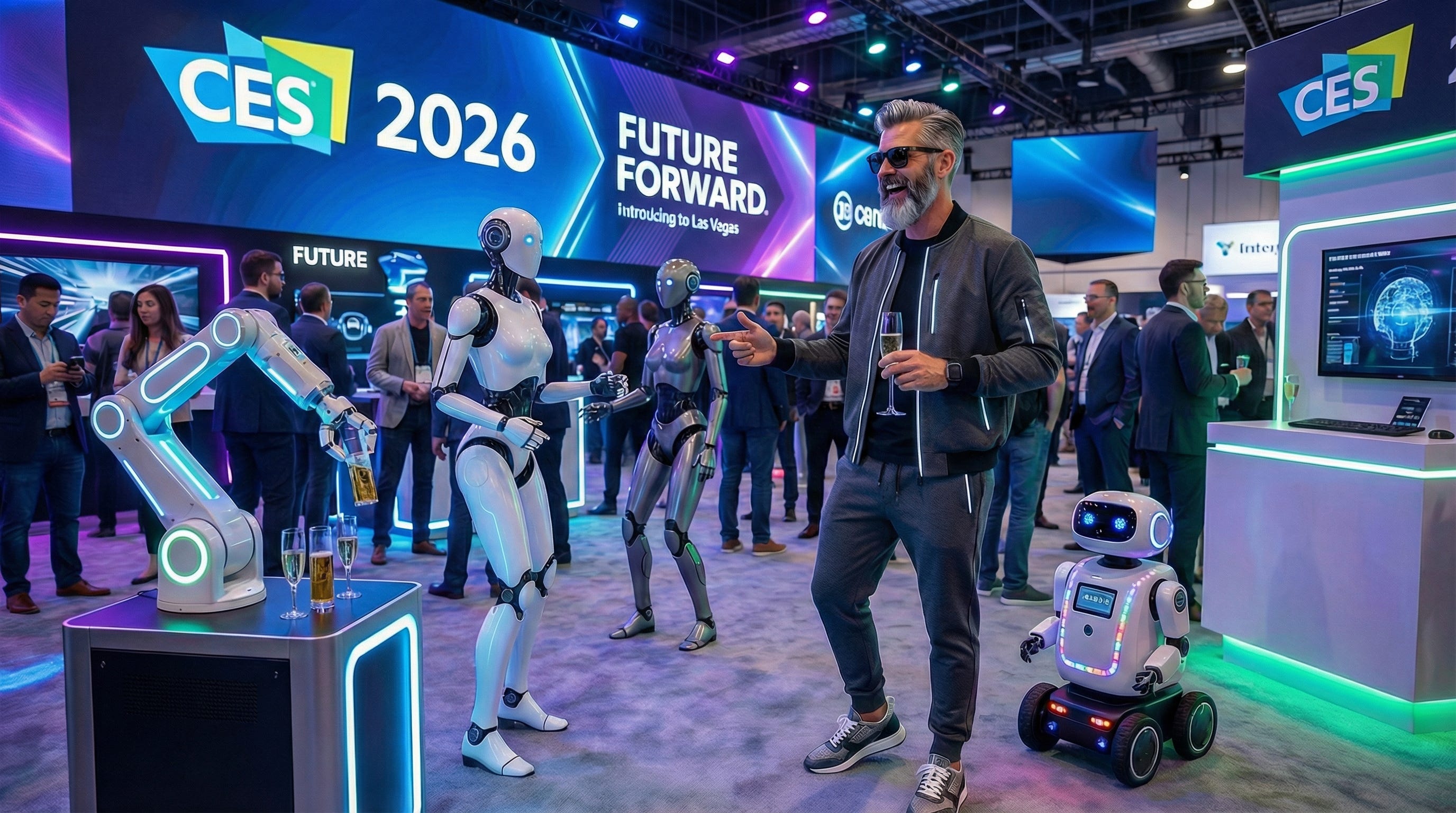
Robots were where one saw the most visible application of AI. They were everywhere this year, doing all manner of tasks, up to and including boxing with each other. They were nearly everywhere you looked, a little too close to customers to be that far off from production. I suspect you will see one sooner rather than later.
Overall AI is starting to get refined into the interface layer and into devices more than being a sticker on everything like it was in 2025.
New Product Categories and Trends
These are a few overall product trends which stuck out to me beyond the AI layers.
Retro Revival
If I had to pick a single visual throughline in products it would be retro. It crept into many different products from across the floor. Bluetooth keyboards shaped like typewriters for example. Some companies are building offline experiences – the Await camera behaves like a disposable camera of old, limited to 24 exposures and no previews. You have to send it to a device for processing. Clicks cases turn your smartphone into a BlackBerry of sorts with a keyboard. Nostalgia sells and it seems offline has a certain charm in 2026.
AI Enabled Smart Rings
There is a new wave of smart rings that are interactive tools rather than health trackers. In particular, the ring makes a great place to launch an AI assistant. They are big enough to have enough microphones. The placement on the hand makes it easy for you to tap a record button as required. Vocci was a good example – working even in tough Eureka Park noise and network envelopes. I am excited to see where these devices go.
E-Ink Art Displays
Brighter, color e-ink screens are powering a new wave of wall art displays. They make more sense than using a real screen – static screens consume next to no power, allowing for battery power with year-long charging cycles. The matte, paper-like screens match modern aesthetics. Lack of backlight means they don’t glow at night and behave like a painting not a screen. Some implementations, such as Framic, let you create AI art for your frame while others include public domain galleries.
Exoskeletons
Mobility augmentation can change lives. It feels like we are getting much closer to consumer exoskeletons – external frames that can support people doing repetitive labor or with mobility problems. There were multiple implementations on the CES tradeshow floor in consumer-ready implementations. Given our aging population this could be an exciting growth area in future years.
The Bottom Line
CES is a slog. I walked 25 miles over two days. The exhibits I saw during the march illustrated two things to me. First, the big Chinese companies are investing heavily in splash, not unlike their Korean and Japanese predecessors who have moved out to quieter venues for more refined conversations. Second, advances in batteries and sensors are combining with manufacturers learning how to apply AI.
Christmas 2026 should be an interesting shopping season.
References
Here are some handy references about this show in case you want to read further.
Last year’s coverage from this newsletter.
CES History from 1440.
Wired’s CES 2026 Live Blog — great curation of the best devices.
Tom’s Guide to CES 2026 — lots of close ups with devices
Robots were everywhere this year. Am I already turning in a curmudgeon when I say that no one actually wants a robot in their home? I think I might be wrong on that one.